
Table of Contents
Do Indians need a visa for a Thailand wedding right now?
As of today, Indian passport holders, including wedding guests and the couple, can still enter Thailand visa for Indians free. Thailand’s Cabinet approved a shorter 30-day exemption for India on 16 July 2026, but it isn’t legally in force yet, it takes effect 15 days after Royal Gazette publication, which hasn’t happened. Until then, the existing 60-day exemption still applies at immigration. Every traveller, including every member of a wedding party, must also submit the free Thailand Digital Arrival Card (TDAC) individually within 72 hours of their own arrival.
Check your wedding dates against the current rules with our team →

Why did Thailand’s visa policy change twice in 2026, and why does that matter for a weddings?
For a solo traveller, a rule that flip-flops for a few weeks is an inconvenience. For a wedding, it’s a planning risk, because the couple usually locks in a date and a guest list six to twelve months ahead, long before this year’s changes were even announced. Understanding both changes is the only way to know which rule actually applies to your wedding dates.
| Date | What happened |
| February 2026 | India added to Thailand’s visa-exemption list at 60 days, up from Visa on Arrival |
| 19 May 2026 | Thai Cabinet approved scrapping the 60-day exemption for 93 countries, including India |
| May–July 2026 | Confusion over the proposal, and premature reports that India had dropped to Visa on Arrival, contributed to a reported drop of roughly 20% in Indian arrivals |
| 15–16 July 2026 | Thai Cabinet reversed course specifically for India: confirmed a 30-day visa exemption, not Visa on Arrival |
| Today | The 30-day rule is Cabinet-approved but awaiting Royal Gazette publication; the 60-day exemption remains in force until then |
The May proposal that worried wedding planners
On 19 May 2026, Thailand’s Cabinet approved a plan to end the 60-day visa exemption for the 93 countries that had it. Early reporting was inconsistent, and several outlets stated that India would be shifted to Visa on Arrival specifically, a change that would have meant every wedding guest filling out a separate VoA form and fee at the airport rather than walking through on a passport stamp. That reporting reflected a genuine possibility under the original proposal, but it was never finalised in that form, which is why some wedding-planning content still online describes India as VoA-only.
The July reversal that kept weddings visa-free
Thailand’s Tourism Minister, Surasak Phancharoenworakul, confirmed on 15 July 2026 that the Cabinet had approved a different outcome for India: a 30-day visa exemption rather than Visa on Arrival. The decision followed a measurable drop in Indian arrivals after the May confusion, and officials specifically cited Indian travellers’ average trip length of 7.2 days as the reasoning for setting the exemption at 30 days rather than reinstating the full 60. A standard multi-day Indian wedding program, even at its most elaborate, comfortably fits inside that 30-day window.
What is the Thailand Digital Arrival Card, and does every wedding guest need to submit it?
Yes, and this is the detail that trips up the most wedding parties. The Thailand Digital Arrival Card (TDAC) is a free online form that replaced most of the old paper arrival process, and it has to be submitted individually, per traveller, within 72 hours before landing, through Thailand’s official immigration portal. There’s no group or family filing option, so a wedding with a hundred guests arriving across three or four different flight days means a hundred separate TDAC submissions, not one submission covering the group.
Anyone coordinating travel for a Thailand Weddings guest list should treat this as a standard line item in the pre-wedding checklist, not an afterthought handled at the airport. Each traveller needs their own passport details, flight information, and the wedding venue or resort’s address on hand to complete it, and it’s worth telling guests to save or print their confirmation, since immigration officers sometimes ask to see it on arrival even though it’s filed electronically.
The TDAC is unrelated to the visa-exemption changes described above. It applies to essentially all foreign arrivals and isn’t something that will change again if the Royal Gazette publication happens or the exemption period shifts.
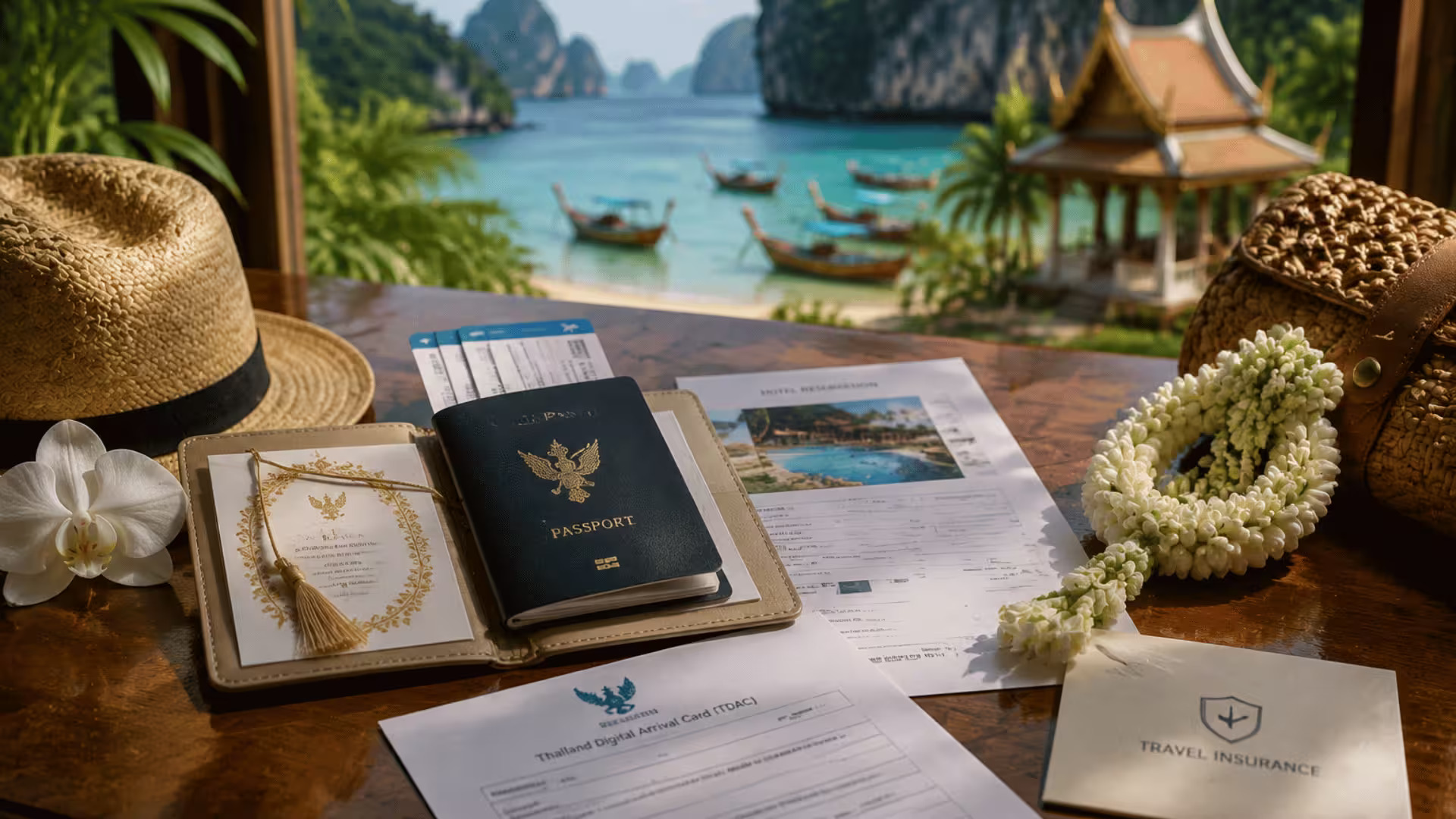
What documents should wedding guests carry through Thailand immigration?
Immigration officers can ask for any of the following, and having them ready, printed where possible, makes entry faster for everyone in a wedding party, not just the couple.
| Document | Notes for wedding travel |
| Passport | Valid for at least 6 months beyond travel dates, worth checking for every guest, not just the couple |
| TDAC confirmation | Filed individually per traveller, 72 hours before arrival |
| Return or onward flight ticket | Confirms no intent to overstay; relevant even for guests staying on for a few extra days |
| Proof of accommodation | The resort or hotel’s booking confirmation; guests staying at the wedding venue can usually use the venue’s group booking reference |
| Proof of funds | Typically 10,000 to 20,000 THB per person; see below |
How much money does a wedding guest need to show at immigration?
Thai immigration can ask travellers to demonstrate sufficient funds, generally cited as around 10,000 THB per person or 20,000 THB per family, though this isn’t checked for every traveller and enforcement varies. For a wedding guest list, it’s worth mentioning this once in the travel note sent to guests rather than assuming everyone already knows, since a recent bank statement or accessible funds on a forex card or banking app is a five-minute preparation step that avoids a real delay if someone is asked and can’t show it.
What if the couple, or a guest, wants to stay longer than the visa-free period?
This comes up more often around weddings than around ordinary holidays, since couples frequently extend for a honeymoon leg or a pre-wedding shoot, and some guests turn the trip into a longer holiday around the event. Extensions are possible but need to be arranged at a Thai immigration office before the visa-free stay runs out, currently at a fee of 1,900 THB, granted at the immigration officer’s discretion rather than automatically. For a stay significantly longer than 30 or 60 days, applying for an e-visa or an appropriate longer-stay visa category before travelling is more reliable than trying to extend at the border.
For the wedding itself, though, neither of these usually applies. A multi-day program, mehendi through reception, comfortably fits inside either the current 60-day or the incoming 30-day exemption with room to spare, so an extension or advance visa is generally unnecessary unless the trip is being deliberately combined with an extended stay elsewhere in Thailand.

Do vendors, photographers or planners travelling from India for the wedding need a different visa?
This is worth answering directly because it doesn’t come up in general visa guides but matters a great deal for a Destination Wedding in Thailand specifically. A photographer, makeup artist, or planning team member travelling from India to work at a Thailand wedding is, from an immigration standpoint, still a tourist entry under the same exemption terms as any guest, provided they aren’t being paid by a Thai entity and aren’t performing work that requires a Thai work permit. In practice, most Indian wedding vendors travelling with a couple’s own event are entering to accompany and support a personal trip, not to take up local employment, and this is the standard basis on which they travel.
Where this gets genuinely more complex is if a vendor is planning an extended stay in Thailand for multiple back-to-back wedding bookings across several weeks, at which point the same exemption-duration math described above starts to apply, and a longer-stay visa category may be worth checking in advance rather than relying on repeated short entries.
| Visa type | Typical use case | Approximate fee (INR) |
| Single-entry tourist visa | Short trips outside the visa-exemption scope | Around 3,000 |
| Multiple-entry tourist visa (6 months) | Vendors or planners with several trips across a season | Around 13,500 |
| Non-immigrant visa | Long-stay work purposes requiring a Thai work permit | Starts around 7,000 |
| Destination Thailand Visa (DTV) | Extended stays for remote work or long-term visits | Around 30,000 |
These fees, published through the Royal Thai Embassy’s revised consular fee schedule effective 27 April 2026, are separate from the standard visa-exemption scheme and apply only to travellers who need one of these categories directly, which most wedding guests and even most vendors on a single booking will not.
Why does Thailand care so much about getting its Indian traveller policy right?
The back-and-forth on this rule wasn’t a minor bureaucratic adjustment, it reflects a country actively correcting course after real economic impact, and understanding the scale explains why the reversal specifically protected leisure and wedding-style travel from India rather than tourism in general.
India is Thailand’s third-largest source market by arrivals, behind only China and Malaysia, with 1.3 million Indian arrivals recorded in the first half of 2026 alone and total arrivals projected to reach roughly 2.55 million by year-end, according to the Tourism Authority of Thailand.
Indian travellers are also comparatively high spenders once they arrive, averaging around 6,200 baht a day and more than 36,000 baht per trip, a spending pattern multi-day wedding groups tend to sit well above given the length of stay and the number of functions involved.
TAT officials have said openly that the shift toward a Visa on Arrival requirement during the interim period caused more confusion, and did more damage to travel demand, than almost any other factor that quarter, with some business and group travel shifting to alternative destinations like Vietnam during the uncertainty.
With the 30-day exemption now confirmed and roughly 66,000 weekly airline seats already running on Thailand-India routes, Thailand’s tourism authorities are projecting a record 2.7 million Indian arrivals once the new policy is fully in effect, a number large-format Indian weddings, with guest lists that can run into the hundreds, contribute to more than most single-traveller holiday bookings do.
Are large wedding guest lists treated differently at Thailand immigration?
Not in terms of the rules themselves, every traveller enters under the same exemption terms regardless of why they’re visiting, but the coordination burden is real and worth planning for deliberately. A hundred-guest wedding means a hundred individual TDAC filings, a hundred sets of return-flight and accommodation proof, and, if the 60-to-30-day transition happens mid-planning, potentially two different permitted-stay durations across the same guest list depending on who travels before the change and who travels after.
This is where most of the actual mistakes happen, not in the rules themselves but in the assumption that a group booking or a shared wedding invitation covers the paperwork. It doesn’t. The couple or the planning team’s job is less about understanding immigration law and more about making sure every individual guest knows they need to complete their own TDAC and carry their own documents, the same way any solo traveller would.
Weddings with a guest list above a hundred people are where this coordination effort pays off most clearly for a Destination Wedding Thailand booking specifically. Smaller weddings, where everyone books flights around a similar window, rarely run into the mixed 60-day and 30-day scenario described above simply because the whole group tends to travel within a day or two of each other. Larger, multi-city guest lists are more likely to have arrivals spread across a week or more, which is exactly the situation where checking the Gazette publication date against your specific dates matters most.
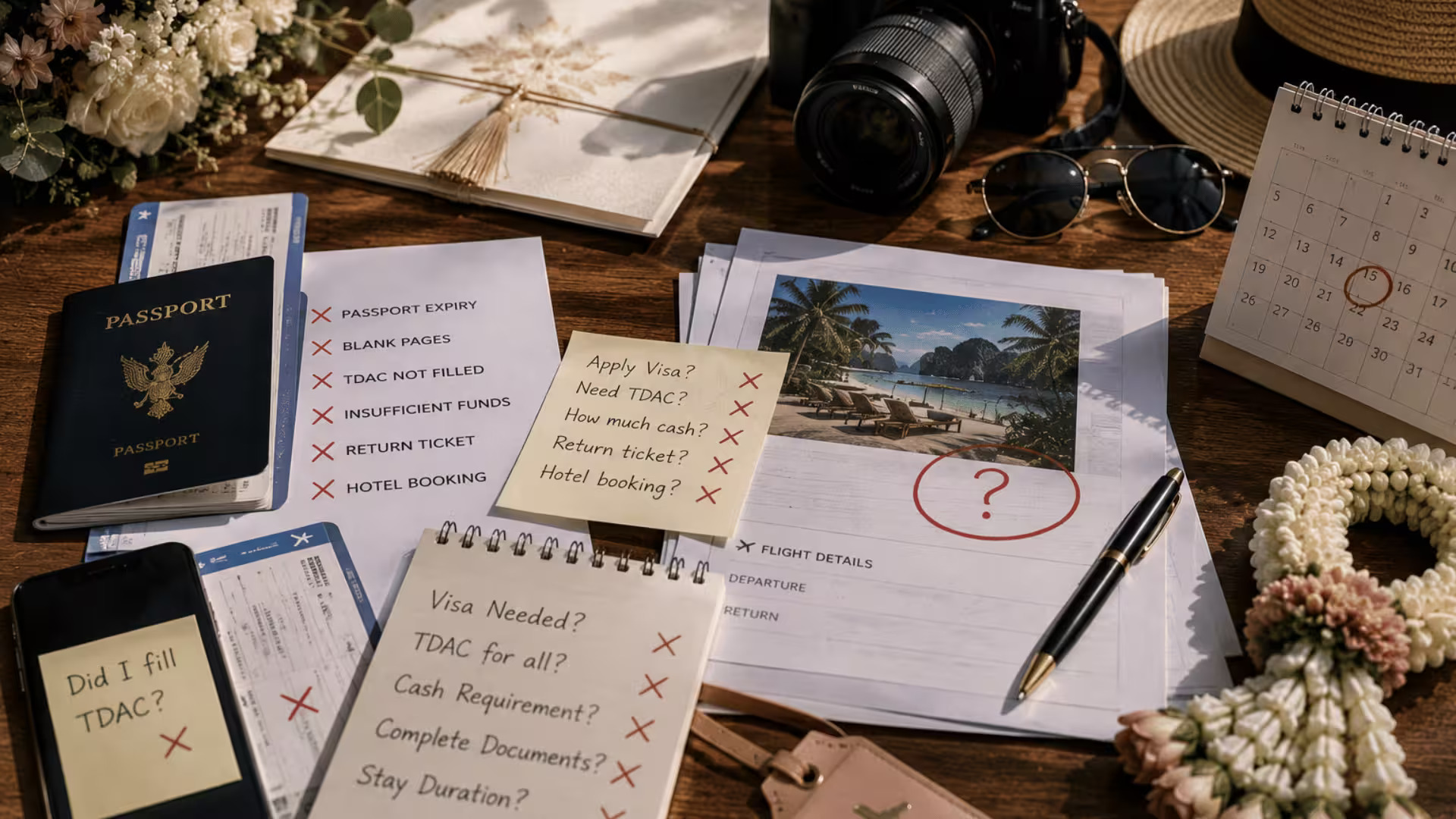
What mistakes do couples and wedding guests keep making with these rules?
A few patterns show up repeatedly, and nearly all of them come from relying on outdated wedding-planning content rather than checking current status directly.
Assuming the May 2026 headlines are still accurate is the most common one. Several widely shared articles from that period describe India as having lost visa-free access entirely, and couples who read only those pieces sometimes brief their guests to expect a Visa on Arrival process that isn’t actually required right now.
Treating the wedding invitation as sufficient travel guidance is a close second. Guests often assume that because they’re travelling as part of an organised wedding group, someone else, the couple, the planner, the venue, has handled the paperwork. Nobody files a guest’s TDAC or checks their passport validity except the guest themselves.
Skipping the TDAC because “visa-free” sounds like “no paperwork” is another frequent mistake, and one worth flagging explicitly in any pre-wedding travel note sent to guests. The TDAC is separate from visa status entirely and is mandatory regardless of which exemption duration applies.
Not checking the Royal Gazette publication date close to the actual wedding date is a mistake specifically relevant right now, while the 30-day rule is approved but not yet active. A couple planning a wedding later this year should check the current status again a few weeks before the event rather than relying on whatever this page or any other page said months earlier, since the effective date wasn’t fixed at the time of writing.
Confusing the TDAC with a visa application is a more subtle mistake, but it shows up often enough to mention. The TDAC only asks for arrival and accommodation details, it doesn’t grant permission to enter the way a visa does, and submitting it isn’t the same as being cleared for entry, that decision still happens at the immigration counter based on passport, ticket, and the exemption terms in effect on the traveller’s arrival date.
What is the simplest way to prepare a wedding guest list for entry into Thailand?
Stripped of all the policy back-and-forth, the actual preparation checklist is short, and it works whether it’s being handled by the couple, a planner, or communicated to guests directly. Roughly 2 to 3 weeks before travel:
Confirm every guest’s passport has at least 6 months of validity remaining from the travel date, since Indian passport renewal itself takes time and this is worth flagging early, not the week of the wedding.
Check the current visa-exemption status against an official source, the Royal Thai Embassy or the TAT newsroom, rather than a wedding blog or the first search result, given how much this specific rule has moved in 2026.
Confirm accommodation for each guest, whether that’s the wedding resort’s group booking or a separate hotel, and make sure guests know the address they’ll need for their TDAC.
Have each guest’s return or onward flight ticket ready to show if asked, since this is one of the more commonly requested documents at immigration.
Set a reminder, ideally sent to the whole guest list, for 72 hours before each person’s flight to submit their individual TDAC.
Remind guests to keep proof of funds accessible, a recent bank statement, a forex card, or a banking app, even though this isn’t checked for every traveller.
None of these steps change based on whether a guest lands under the 60-day or 30-day rule, which is part of why the headline confusion earlier this year mattered less in practice than it seemed to at the time, provided the basic checklist is followed regardless.
How does India’s 30-day rule compare with other countries affected by this change?
India wasn’t the only country whose visa-exemption terms shifted in this round of changes, and seeing where it sits relative to others gives a useful sense of scale for anyone weighing Thailand against another destination for the wedding. According to Thai government spokesperson Ploytalay Laksameesangchan, the 30-day exemption category now covers roughly 60 countries and territories, including India, Bulgaria, Croatia, Cyprus, Malta, and the Maldives, alongside all 27 European Union member states.
| Country/region | Previous terms | Current terms (2026) |
| India | 60-day exemption | 30-day exemption (pending Gazette publication) |
| Maldives | 60-day exemption | 15-day exemption |
| Seychelles | 60-day exemption | 15-day exemption |
| China | Bilateral 30-day agreement | Unchanged |
| South Korea | Bilateral 90-day agreement | Unchanged |
India’s outcome, a reduction rather than a sharper cut to 15 days or a shift to Visa on Arrival, reflects the specific reversal described earlier: Thailand’s Cabinet treated India differently from several other affected nations precisely because of the scale of Indian tourism, a category destination weddings contribute to meaningfully given typical guest-list sizes and trip length.
How should couples planning a Thailand wedding stay updated on these rules?
Given how much this specific policy has moved in 2026, checking a single article months before the wedding and considering the question settled isn’t reliable. The two sources that matter most are the Royal Thai Embassy’s website, which publishes visa and consular fee updates directly, and the Tourism Authority of Thailand’s official newsroom, which covers Cabinet decisions on visa policy as they’re confirmed.
Indian news coverage of Thai Cabinet announcements has generally been accurate once the dust settles on each change, but the fastest-moving initial reports, particularly around the May 2026 proposal, were the ones that ended up needing correction, so a claim reported the same week as a Cabinet meeting deserves a second check a few days later against an official source.
A wedding date set for later this year sits comfortably past the point where the 30-day rule will almost certainly already be in force, so planning guest logistics around 30 days rather than 60 is the safer working assumption for any wedding more than a few weeks out from today.
Checking the travel window against seasonal weather is worth doing at the same time as checking visa status, since both affect the same set of dates. The best time to visit Thailand walks through the seasonal breakdown in more detail if the wedding date itself still has flexibility.

How can Thailand Weddings help you plan around these rules?
We track these rule changes specifically because our couples and their guests are directly affected by them, not as a general travel-blog exercise. If you’re planning a Thailand wedding trip for yourself or coordinating travel guidance for a guest list, we can walk through what the current visa status means for your specific date range, including how the 60-to-30-day transition might affect guests arriving on different days.
Once your travel dates and venue are settled, it’s worth cross-checking your guest list’s individual arrival windows against whichever exemption duration applies once the Royal Gazette publication happens, since that’s the detail most likely to catch a family or friend group off guard, especially on a guest list large enough that not everyone is travelling on the same day.
Talk to our team about your wedding dates and guest travel →
Frequently asked questions
Is Thailand visa-free for Indians planning a wedding in 2026?
Yes, as of this page’s last verification. The stay duration is transitioning from 60 days to 30 days following a Thai Cabinet decision confirmed on 16 July 2026, but the change takes legal effect only after Royal Gazette publication, which hadn’t occurred as of writing. Check current status close to your wedding date, since this is actively changing.
Do wedding guests need a visa on arrival for Thailand?
No. Despite some May 2026 reports suggesting India would move to Visa on Arrival, Thailand’s Cabinet confirmed on 15 July 2026 that India retains visa-free entry, just at a reduced 30-day duration once the new rule takes legal effect.
Does every wedding guest need to file their own TDAC, or can the couple file one for the entire group?
Each traveller, including every wedding guest, needs to submit their own TDAC individually within 72 hours of their own arrival. There’s no group or family filing option, even for guests travelling together for the same event.
What happens if Thailand’s visa rules change between booking and the wedding?
Based on official statements, travellers who enter before the new 30-day rule takes legal effect keep the full stay duration granted at entry, currently 60 days, even if the rule changes while they’re already in the country. A wedding party arriving across several days around the change-over could see some guests on 60 days and others on 30, depending on exact arrival dates.
Do wedding vendors travelling from India need a different visa?
Generally no, provided they’re accompanying a personal event rather than taking up paid work with a Thai entity, in which case they travel under the same visa-exemption terms as any guest. Vendors booking multiple weddings back-to-back over an extended stay should check longer-stay visa categories rather than relying on repeated short entries.
How much cash do wedding guests need to show at Thailand immigration?
Immigration officers can ask travellers to demonstrate roughly 10,000 THB per person or 20,000 THB per family in accessible funds, though this isn’t checked for every traveller. It’s worth including this in the travel note sent to your guest list as a simple precaution.
Can the couple extend their stay in Thailand after the wedding for their honeymoon?
Yes, extensions are available at Thai immigration offices before the current permitted stay ends, currently at a fee of 1,900 THB, though granted at the immigration officer’s discretion rather than automatically. Most honeymoon extensions comfortably fit inside the existing exemption window without needing this step at all.
Where can I check the latest Thailand visa information for Indians before finalising wedding travel plans?
The Royal Thai Embassy’s official website and the Tourism Authority of Thailand’s newsroom are the two most reliable sources, since both publish policy changes directly rather than through secondhand wedding-blog reporting.