

Yes, you can plan a strict Jain wedding in Thailand if you choose the right hotel and brief its kitchen properly. Look for an experienced Indian chef, separate Jain utensils, written menu approval and a tasting. The hotel should also be able to serve dinner before sunset for guests who observe chauvihar.
Thai cooking often uses fish sauce, shrimp paste, garlic and onion, so “vegetarian” in Thailand doesn’t always mean Jain.
This guide covers what to ask hotels, which ingredients to avoid, and how to plan meals and rituals.
Table of Contents
What Makes a Jain Wedding Different When You Celebrate Abroad?
A Jain wedding abroad needs more planning than most Indian weddings in three areas: food, timing and rituals.
Food is stricter than vegetarian. Jain food excludes meat, fish and eggs, but also honey, root vegetables, mushrooms and, for many families, certain other vegetables and fermented foods.
Timing matters. Families who observe chauvihar finish their last meal before sunset, which changes how you plan dinners and evening functions.
Rituals follow Jain tradition. The ceremony includes Jain prayers and worship and is usually led by a Jain vidhikarak (Jain priest) or pandit familiar with Jain rites.
Families also differ in how strictly they observe these rules. In a 2021 survey of Indian Jains, 92% followed a vegetarian diet and 67% avoided root vegetables. So before you talk to any hotel, agree within the family which level of observance the menu must meet.
Jain Food Rules Every Hotel Chef Must Understand
Your hotel’s kitchen needs a clear, written list of what Jain food excludes and why. Most chefs in Thailand understand vegetarian and vegan cooking. Fewer understand the Jain rules below.
| Not allowed in strict Jain food | Includes |
| Meat, fish, eggs | Also stocks, gelatine, egg glazes |
| Honey | In desserts, dressings, drinks |
| Root vegetables | Potato, onion, garlic, carrot, beetroot, radish, ginger, lotus stem |
| Fungi and yeast | Mushrooms; for some families, yeast-raised breads |
| Alcohol | In cooking or desserts |
| Stale or overnight food | Food cooked the day before, overnight curd |
| Some multi-seeded vegetables | Brinjal (eggplant), cauliflower, cabbage, figs, for stricter families |
Fermented foods need care too. Strict Jain practice avoids batters fermented overnight, such as idli, dosa or dhokla, unless prepared fresh with alternatives like baking soda. Curd should be set fresh and eaten the same day.
During Paryushan, many Jains also avoid green leafy vegetables. If your wedding dates are close to it, check with your family.
The Hidden Thai Ingredients That Break Jain Rules
The biggest risk at a Jain wedding in Thailand isn’t meat on the menu. It’s ingredients hidden inside sauces, pastes and stocks that kitchen staff may not think of as non-vegetarian.
Ask your hotel to confirm in writing that none of these appear in Jain dishes:
- Fish sauce (nam pla): used in many Thai dishes, dressings and dips
- Oyster sauce: common in stir-fries
- Shrimp paste (kapi): found in most Thai curry pastes
- Ready-made curry pastes: often contain shrimp paste, garlic and shallots
- Chicken or fish stock: used in soups, rice and sauces
- Garlic and shallots: the base of most Thai cooking
- Honey: in glazes, dressings and mocktails
- Eggs: in noodles, batters, desserts and some breads
A helpful Thai term: “jay” (เจ). Thai “jay” food is a Thai-Chinese vegetarian tradition that avoids meat, fish sauce, garlic and onion. Thai chefs know it well, especially around Thailand’s Vegetarian Festival, which is usually held in October. Jay food is a useful starting point, but it isn’t fully Jain: it often includes potatoes, carrots, mushrooms and other root vegetables. Tell the chef your menu is “jay, plus no root vegetables, no mushrooms and no honey”.
How to Choose a Hotel for Strict Jain Catering in Thailand
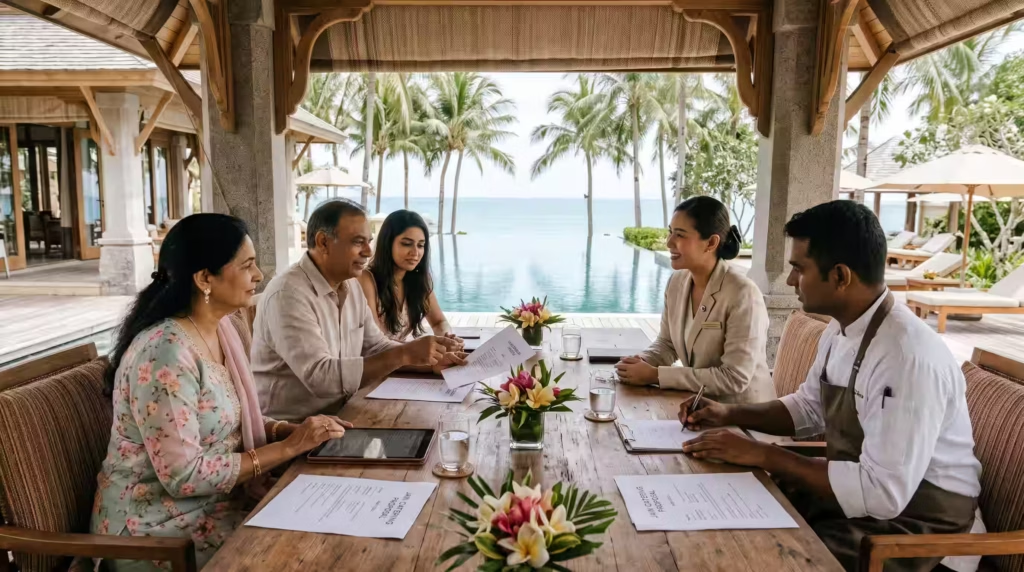
The right hotel isn’t the one with the most famous restaurant. It’s the one whose banquet team will follow Jain rules consistently for every meal, across several days and hundreds of guests. Use these eight criteria when shortlisting.
1. An experienced Indian chef or Indian banquet team
Hotels that regularly host Indian weddings are far more likely to understand Jain food. Ask how many Indian weddings the hotel hosted last season, and whether it has an Indian chef on staff or works with a specialist Indian caterer.
2. A separate preparation area and utensils
For strict Jain families, Jain food should be cooked with separate utensils, pans and serving ware, away from meat and seafood. Ask whether the hotel can set aside a dedicated preparation area for the wedding.
3. Written menu sign-off, dish by dish
Ask for every Jain dish to be listed with its full ingredients, and approve it in writing. This is the single most effective way to prevent mistakes.
4. A tasting before the wedding
Arrange a menu tasting before the wedding, or at least on the first evening, with the head chef present. It lets you correct any dish before the main functions.
5. Clear policy on outside cooks
Many Jain families prefer to bring a trusted Jain cook (maharaj) from India. Ask the hotel whether outside cooks can work in its kitchen, and what permissions they need, since Thailand has rules on foreigners working. Your planner can help confirm the right route.
6. Separate, labelled Jain counters
Most Jain weddings also have non-Jain guests. Ask for a separate Jain counter with its own serving spoons, clearly labelled, so dishes don’t mix at the buffet.
7. Flexible meal timings
If family members observe chauvihar, the hotel must be able to serve dinner before sunset. In Thailand, sunset is roughly between 6 and 7 pm, depending on the season and location. Check that the kitchen and venue can be ready earlier than a typical banquet.
8. Boiled or filtered water on request
Some strict Jain guests drink only boiled or carefully filtered water. Ask whether the hotel can provide it in rooms and at functions.
Questions to Ask Every Hotel Before You Book
Send these questions to each shortlisted hotel, and ask for answers in writing:
- How many Indian weddings did you host last year, and were any of them Jain?
- Do you have an Indian chef, or do you partner with an Indian caterer?
- Can you prepare Jain food with separate utensils and a separate preparation area?
- Can you provide written ingredient lists for every Jain dish?
- Will you confirm that no fish sauce, oyster sauce, shrimp paste, stock, garlic, onion, root vegetables, mushrooms, eggs or honey will be used?
- Can we hold a menu tasting with the head chef?
- Can we bring our own Jain cook from India, and what’s required?
- Can dinner be served before sunset for chauvihar guests?
- Can you set up a separately labelled Jain buffet counter?
- Can you provide boiled or filtered water for guests who need it?
A hotel that answers clearly, without hesitation, is usually a hotel that has done this before.
Which Thailand Destination Is Best for a Jain Wedding?

Bangkok has the deepest support for Jain families, while beach destinations rely mainly on the resort’s own kitchen.
Bangkok has an established Jain community, mainly Gujarati and Rajasthani families, according to Asia Global Partners. It also has Jain places of worship and pure-vegetarian Indian kitchens around Phahurat and Sukhumvit. That makes it easier to source Jain ingredients, cooks and community support.
Phuket has a strong Indian wedding industry, and resort kitchens are the most reliable base. In wedding season they’re often supported by Indian restaurants and caterers.
Hua Hin is about three hours by road from Bangkok, so Bangkok-based Indian caterers and suppliers are relatively close.
Krabi and Khao Lak offer beautiful, quieter settings, but rely more heavily on the resort kitchen. Brief the hotel early, and consider bringing specialist support.
Compare these locations in our guide to Thailand wedding destinations.
Hotels to Consider for a Jain Wedding in Thailand
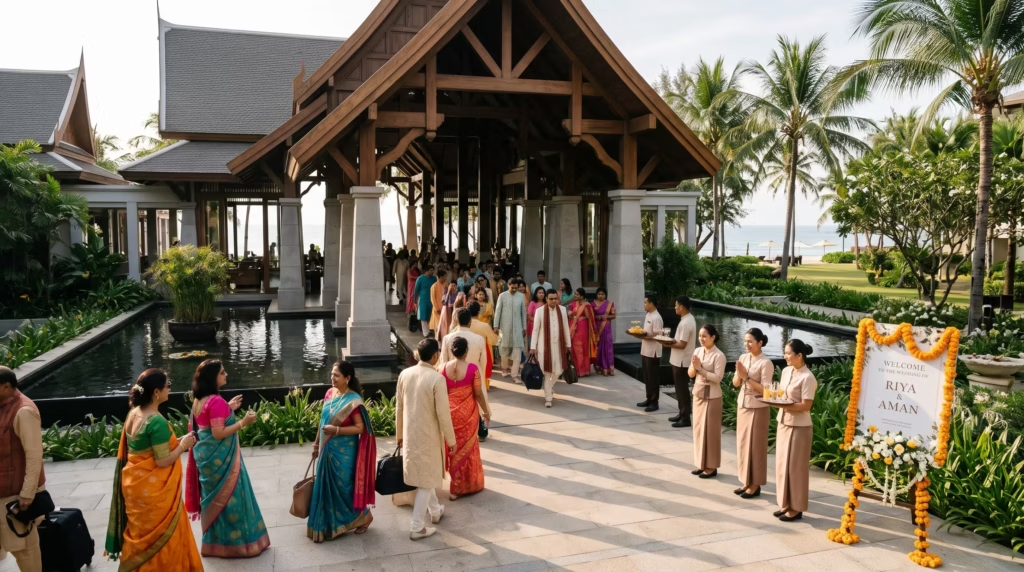
These venues are well suited to large Indian weddings. As with any hotel, confirm Jain catering arrangements in writing before booking.
| Destination | Venue | Why it suits a Jain wedding |
| Hua Hin | Avani+ Hua Hin Resort | Has hosted many Indian weddings; dedicated banquet kitchen next to the ballroom |
| Hua Hin | Dusit Thani Hua Hin | Ballroom for up to 1,100 guests; 296 rooms |
| Hua Hin | Sheraton Hua Hin Resort & Spa | Column-free ballroom; 240 rooms |
| Hua Hin | SO/ Sofitel Hua Hin | Has worked with an in-house Indian chef; design-led setting |
| Phuket | JW Marriott Phuket Resort & Spa | Experienced with Indian weddings; 15–20 minutes from the airport |
| Phuket | Angsana Laguna Phuket | Ballroom seating up to 800 at banquet tables |
| Phuket | Le Méridien Phuket Beach Resort | 470 rooms to keep families together |
| Bangkok | Bangkok Marriott Marquis Queen’s Park | City location with access to Bangkok’s Indian vegetarian suppliers |
| Bangkok | Anantara Riverside Bangkok Resort | Riverside setting with access to Bangkok’s Indian community |
| Khao Lak | JW Marriott Khao Lak Resort & Spa | Large beachfront resort for big weddings |
| Krabi | Banyan Tree Krabi | Private, luxury setting for smaller Jain weddings |
How to Plan Meals Around Sunset (Chauvihar)
If close family members observe chauvihar, plan your wedding schedule around daylight rather than fitting meals into a typical evening timetable.
Make lunch the main feast. Many Jain families hold the main wedding meal at lunch, which suits a morning or midday ceremony.
Serve dinner early. Plan evening meals to finish before sunset, roughly 6 to 7 pm in Thailand, and schedule the sangeet or music after the meal.
Keep late-night food separate. If non-Jain guests want a late dinner or after-party, set it up separately so it doesn’t clash with family observance.
| Time | Example schedule for a Jain wedding day |
| Morning | Jain puja and pre-wedding rituals |
| Late morning | Baraat (Var Ghodo) and wedding ceremony |
| Lunch | Main wedding feast with a full Jain menu |
| Afternoon | Rest, photos, guest free time |
| Before sunset | Early dinner for chauvihar guests |
| Evening | Reception or sangeet entertainment |
Jain Wedding Rituals: How to Plan Them in Thailand
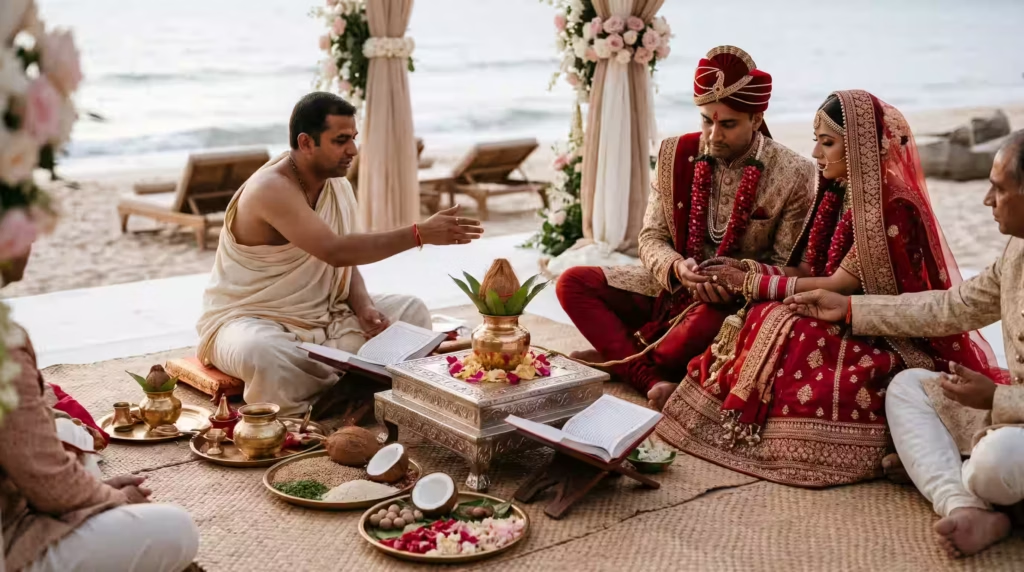
Jain wedding rituals can be performed fully at Thai resorts, as long as you plan the priest, puja items and spaces in advance.
The order varies between families and communities, but a Jain wedding typically includes:
- Vagdana: the families’ formal agreement to the marriage
- Mandap and vedi preparation: setting up the canopy and sacred platform
- Var Ghodo: the groom’s arrival, traditionally on horseback
- Torana vidhi and Var Mala: rituals at the entrance and exchange of garlands
- Kanyadaan: the bride’s father gives his daughter in marriage
- Deva-Shastra-Guru puja: worship of the Jina, the scriptures and the gurus
- Agni pradakshina and granthi bandhan: circling the sacred fire and tying the knot
- Ashirvad: blessings from elders
- Daan: donations to a temple or charity, often made in the couple’s name
Who performs the ceremony?
A Jain vidhikarak or a pandit familiar with Jain rites is preferred. Many families bring their priest from India. Check entry requirements for anyone travelling to officiate, and confirm the arrangement with your planner early.
What should you bring from India?
Jain puja items, specific idols or pictures, Jain books and some ritual materials may be easier to bring from home than to source in Thailand. Make a list with your priest, and carry essential items in your hand luggage.
Can you have a sacred fire at a Thai resort?
Yes. Resorts that host Indian weddings can usually arrange a sacred fire in the mandap with prior approval. Confirm safety rules before booking.
Can families visit a Jain place of worship?
Bangkok’s Jain community maintains places of worship. Your planner can help arrange a visit if you’re travelling through Bangkok.
When Should You Plan a Jain Wedding in Thailand?
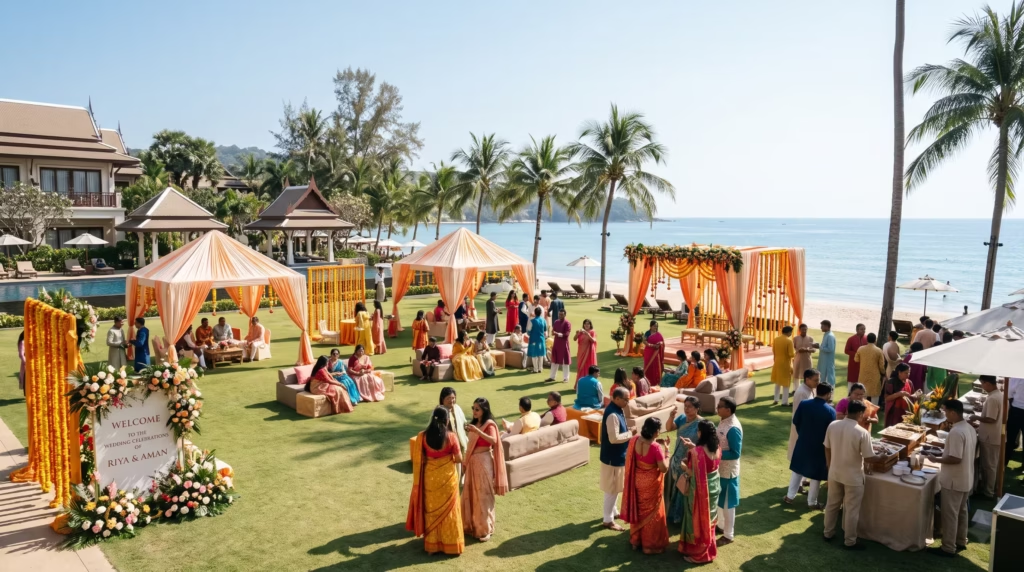
The best time for a Jain wedding in Thailand is usually November to February, which brings two advantages.
The weather is at its best. Phuket’s Andaman coast and Hua Hin’s Gulf coast are both generally dry and pleasant in these months.
It avoids Chaturmas. Many Jain families avoid weddings during Chaturmas, the four-month monsoon period of heightened observance, which ends around October or November depending on the lunar calendar. Paryushan, which usually falls in August or September, is also a time when families are focused on fasting and prayer.
Check exact dates with your family priest, then align them with Thailand’s season. See our guide to the best time to visit Thailand.
Planning Checklist for a Jain Wedding in Thailand

- Agree the family’s level of Jain observance.
- Choose dates after Chaturmas and away from Paryushan.
- Shortlist hotels with Indian wedding experience.
- Send every hotel the ten questions above.
- Approve a written, dish-by-dish Jain menu.
- Book a tasting with the head chef.
- Confirm separate utensils, preparation and buffet counters.
- Plan meals around sunset for chauvihar guests.
- Arrange your Jain priest and puja items early.
- Brief your planner on every family requirement.
At Thailand Weddings, we help Jain families shortlist the right hotels, brief chefs, approve menus and plan rituals, so you can enjoy a destination wedding in Thailand without compromising on faith. Explore our Thailand wedding packages, or read our tips to plan a wedding in Thailand.
Frequently Asked Questions
Can you have a strict Jain wedding in Thailand?
Yes. Choose a hotel with Indian wedding experience, approve a written Jain menu, arrange a tasting, and confirm separate utensils and preparation.
Is Thai vegetarian food Jain?
Not automatically. Thai vegetarian dishes may contain fish sauce, oyster sauce, shrimp paste, garlic, onion or root vegetables, so every dish must be checked.
What is “jay” food in Thailand?
Jay (เจ) is a Thai-Chinese vegetarian tradition without meat, fish sauce, garlic or onion. It’s a good starting point, but it often includes root vegetables and mushrooms, which Jain food excludes.
Which Thai ingredients should Jain guests avoid?
Fish sauce, oyster sauce, shrimp paste, ready-made curry pastes, meat or fish stock, garlic, shallots, eggs and honey.
Can we bring our own Jain cook to Thailand?
Sometimes. Ask the hotel whether outside cooks can work in its kitchen, and confirm any permissions needed before signing the contract.
How do we manage chauvihar at a Thailand wedding?
Plan the main feast at lunch and serve dinner before sunset, roughly 6 to 7 pm in Thailand. Schedule entertainment after the meal.
Which Thailand destination is best for a Jain wedding?
Bangkok has the strongest Jain community and supplier network. Phuket and Hua Hin are also good options with experienced resort kitchens.
When is the best time for a Jain wedding in Thailand?
Usually November to February, when the weather is good and Chaturmas has ended.
Can Jain wedding rituals be performed at a Thai resort?
Yes. Resorts can set up a mandap and sacred fire with prior approval, and many families bring a Jain priest from India.
How do we cater for Jain and non-Jain guests together?
Serve a separate, clearly labelled Jain counter with its own utensils, alongside the general menu.